
Why the InteMind Method® – The deeper truth behind the framework

I never set out to create a method. I set out to understand why people—brilliant, aware, deep-feeling people—could know exactly what wasn’t working in their lives… and still feel stuck. I watched clients have powerful insights. I watched them cry, laugh, uncover old wounds, reframe thoughts, say things like, “I know this isn’t true, but I still feel it.” And that line stayed with me.
Insight wasn’t enough. Mindset shifts weren’t enough. Knowing better didn’t mean doing better—or feeling better—or being free. So I started paying attention. Obsessively. To what actually created movement. To what opened something real. To what helped people not just understand their lives, but live differently—breathe differently—become different.
“I didn’t set out to create a method—I listened and one revealed itself.
The InteMind Method® was created from silence and observation rather than strategy.”
The InteMind Method® was born, not from a whiteboard, but from lived experience. From sessions. From silence. From listening to the space between what was said and what was still hiding beneath it. This wasn’t something I decided to create—it was something I noticed, again and again, and eventually gave shape to.
One of the pivotal moments in this work came during my research into addiction. I’ve always been drawn to understanding the why behind addictive patterns—not just the behaviour, but the pain beneath it. The more I explored, the clearer it became: addiction isn’t just about what people are running to, it’s about what they’re running from. And healing doesn’t happen by dissecting the pain alone.
What I found is that people who had moved beyond addiction—who had found real, lasting freedom—hadn’t done it through insight or logic alone. They had touched something deeper. They’d gone beyond identity. They’d found inner knowing. They’d remembered their connection to something greater—something sacred. And when I spoke to them about it, they affirmed what I had seen in practice: that the deeper layers are where real change begins.
And yet, going straight to those deep layers without safety, structure, or integration doesn’t work either. I saw just as many challenges in spaces that focused only on the spiritual or transpersonal—where clients were encouraged to transcend their pain without ever learning how to be with it. As Robert Masters (2010) writes in Spiritual Bypassing, when we leap too quickly into the spiritual, we often end up bypassing the very psychological material that most needs attention. Real healing, I began to see, isn’t about escape. It’s about presence. It needs to meet people exactly where they are—in their story, their identity, their knowing, and their not-knowing.
And so, I started mapping what I was seeing in my clients—and in myself. What emerged was a clear, fluid, and deeply human rhythm: four levels of transformation that people move through, not always in order, but always meaningfully. These became the Four Levels of the InteMind Method®: Story, Identity, Inner Knowing, and Deep Knowing.
Each of these levels is supported by the very research I had immersed myself in. Narrative work, for example, is at the heart of trauma integration and meaning-making. Pals (2006) demonstrated how processing life events through storytelling can lead to positive self-transformation, while Tedeschi and Calhoun’s (2004) work on post-traumatic growth revealed how people reconstruct identity in the wake of suffering. Identity work, then, isn’t just reflective—it’s essential.
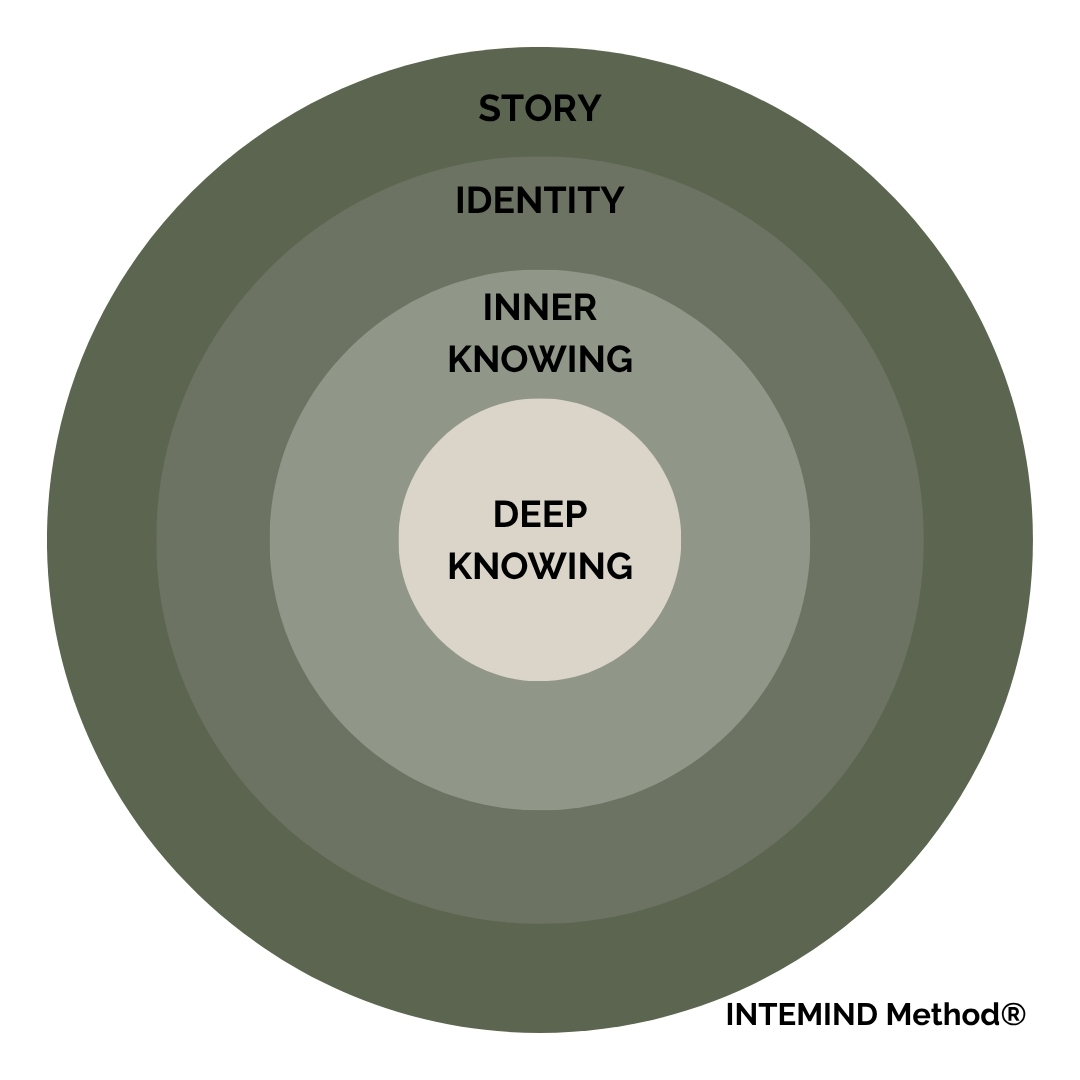
But the most powerful shifts came when clients began connecting to something deeper within themselves—what Welwood (2000) describes as the awakening of core consciousness, and what Newberg and Waldman (2009) call “enlightenment with a small ‘e’.” These aren’t necessarily mystical experiences. They’re subtle shifts—moments of stillness, glimpses of truth, a return to a sense of self that feels whole. And later, in the space I call Deep Knowing, that sense expands. It’s where clients often experience a profound connection to something greater—whether it’s nature, source, soul, or the sacred.
“You can rewrite the story and reshape the identity—but until you touch what lies beneath, it won’t hold.”
Most approaches stop at the first two levels—story and identity. They help people reframe their past, rewrite their beliefs, challenge their patterns. And for a while, that can feel like enough. But eventually, the same issues creep back in. Clients find themselves repeating familiar cycles, even though they understand what’s happening. That’s because the deeper layers haven’t been touched—not truly.

The InteMind Method® doesn’t fix people. It walks with them. It listens. It allows. It doesn’t bypass pain, nor does it glorify it. It simply creates space for people to meet themselves—fully, honestly, and gently. It honours the emotional, the cognitive, the intuitive, and the spiritual—without imposing a belief system or asking people to skip over the hard parts.
There wasn’t a model that honoured this process in a way that felt grounded, non-dogmatic, and real. So I created it. Not because I wanted a signature method. But because I needed one. My clients needed one. My students needed one. One that could hold story, spirit, identity, intuition—all at once. One that didn’t teach people how to detach, but how to stay present through it all.
The InteMind Method® is now a registered trademark, and is taught exclusively through the Australian School of Holistic Counselling (ASHC) and Intemind International in the UK. It’s being used by practitioners who want to go deeper—beyond cognition, beyond tools and scripts, into the layered terrain of real transformation.
In a world full of surface-level solutions and fast-fix formulas, this work is slow. It’s intentional. It honours the mystery, not just the methods we use. And it keeps asking the most important question: What would happen if we stopped trying to fix people and instead walked beside them as they found their way back to themselves?
For me, that’s not just the foundation of the InteMind Method®.
That’s the kind of healing I believe in.
Want to know more about how the InteMind Method® can support you and your clients?
Check out the free guide below:
References
Masters, R. A. (2010). Spiritual bypassing: When spirituality disconnects us from what really matters. North Atlantic Books.
Newberg, A., & Waldman, M. R. (2009). How God changes your brain: Breakthrough findings from a leading neuroscientist. Ballantine Books.
Pals, J. L. (2006). Narrative identity processing of difficult life experiences: Pathways of personality development and positive self-transformation in adulthood. Journal of Personality, 74(4), 1079–1110. https://doi.org/10.1111/j.1467-6494.2006.00403.x
Tedeschi, R. G., & Calhoun, L. G. (2004). Posttraumatic growth: Conceptual foundations and empirical evidence. Psychological Inquiry, 15(1), 1–18. https://doi.org/10.1207/s15327965pli1501_01
Welwood, J. (2000). Toward a psychology of awakening: Buddhism, psychotherapy, and the path of personal and spiritual transformation. Shambhala.